Carpet Sanitizing vs. Disinfecting: What Your Office Actually Needs
Quick Answer: Cleaning removes visible dirt, sanitizing reduces bacteria to a level considered safe by public health standards, and disinfecting is registered to eliminate specific pathogens, and the three are not interchangeable steps. Carpet adds a layer of complexity because most EPA-registered disinfectants are tested and labeled for hard, nonporous surfaces, so professional carpet treatments typically rely on antimicrobial or sanitizing products formulated specifically for textile fibers. Routine sanitization targets the bacteria, dust mite waste, and allergen buildup that settle into carpet fibers from daily foot traffic. A facility usually needs to step beyond routine sanitizing and into a targeted response after a known illness outbreak, a bodily fluid spill, or a period of unusually high traffic through shared spaces like reception areas and break rooms.
Cold and flu season moves through an office differently than it moves through a house. Dozens of people walk the same reception carpet, sit in the same conference room chairs, and pass through the same break room in a single day, and whatever they're carrying often ends up in the carpet fibers underfoot before anyone notices. A facility manager who orders "a deep clean" after a rough flu season and expects the same result as ordering "a disinfecting service" is often surprised to learn those are two different jobs with two different outcomes.
Understanding what separates cleaning, sanitizing, and disinfecting on carpet, specifically, helps facility teams request the right service and set realistic expectations for what it actually does.
Cleaning, Sanitizing, and Disinfecting Are Three Different Steps
Public health agencies draw a clear line between these three terms even though most people use them interchangeably. Cleaning is a physical process, removing dirt, dust, and debris through vacuuming, extraction, or agitation. It makes a surface look better and removes some germs along the way, but it isn't formulated or tested to reduce bacteria counts on its own.
Sanitizing goes a step further. A sanitizing product is registered to reduce bacteria to a level considered safe under public health standards, without necessarily eliminating every organism present. Disinfecting is the strongest of the three, formulated to eliminate specific, identified pathogens, usually with a longer contact time and a higher concentration than a sanitizer requires.
The order matters as much as the terminology. A surface generally needs to be cleaned before a sanitizer or disinfectant can work as intended, since dirt and organic material left on a surface can shield bacteria from the product and reduce its effectiveness.
Why Disinfecting Carpet Isn't as Simple as Disinfecting a Countertop
Most disinfectant products on the market are tested and labeled for hard, nonporous surfaces like countertops, doorknobs, and restroom fixtures. Carpet is porous and fibrous, which changes how a product behaves on it. A liquid that sits on the surface of a countertop long enough to meet its labeled contact time behaves very differently once it's absorbed into carpet backing and fiber.
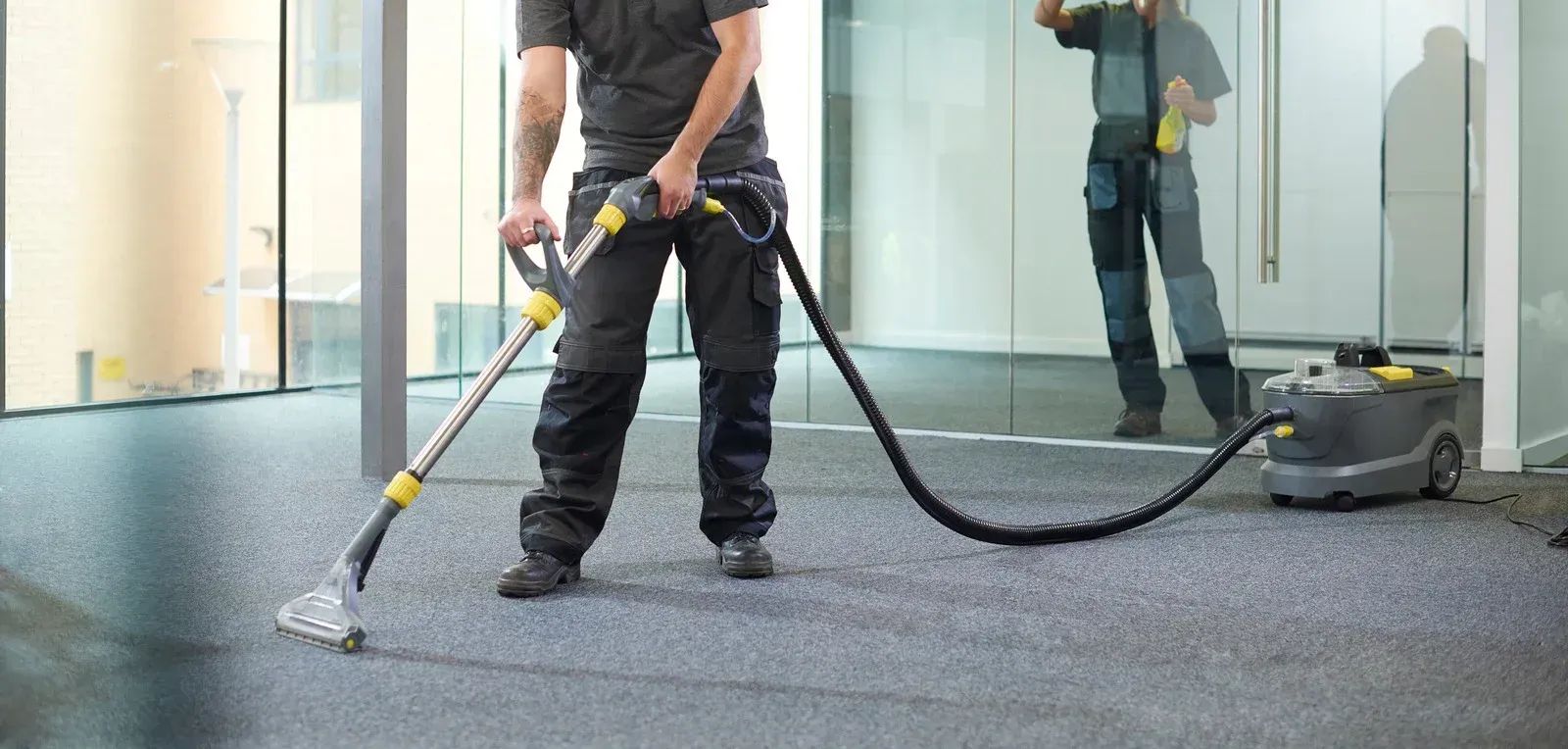
This is part of why the carpet cleaning industry treats "sanitizing" and "disinfecting" as related but distinct services when it comes to textile floor coverings. Professional treatments for carpet typically use antimicrobial or sanitizing agents developed specifically for fiber and backing material, applied as part of the cleaning process rather than as a standalone wipe-down step. The goal is to reduce the bacterial load living in the carpet and inhibit regrowth between cleanings, which is a different claim than the total pathogen elimination associated with hard-surface disinfecting.
Facility teams evaluating a provider should ask what the sanitizing product is formulated for, since a product built for hard surfaces won't necessarily perform the same way once it's worked into carpet pile.
What's Actually Living in Office Carpet
Carpet fibers trap far more than what's visible on the surface. Foot traffic tracks in bacteria, mold spores, and dust mite waste from outside, and all of it settles down into the pile over time rather than staying on top where a vacuum can reach it easily. Independent research presented to indoor air quality groups has found that professional carpet cleaning removed roughly 75 to 99 percent of dust mite, mold, and pet allergens trapped in carpet, depending on the method and how heavily soiled the carpet was beforehand.
That trapping effect isn't purely negative. Carpet fibers hold onto particles rather than letting them recirculate into the air the way a hard floor can, which is why regular extraction and sanitization matters more than a quick vacuum. Left unaddressed for too long, though, that same trapped material becomes a steady source of allergens and bacteria that gets kicked back into the air every time someone walks across the room.
Conference rooms, reception areas, and break rooms tend to accumulate the most buildup because they see the highest volume of foot traffic and, in break rooms, food and drink spills that create a food source for bacteria.
When Routine Cleaning Isn't Enough
A standard cleaning and sanitizing schedule handles the everyday buildup from normal office use. Certain situations call for something more targeted than the routine visit.
- A confirmed illness outbreak moving through the office, where several employees report the same symptoms within a short window
- A bodily fluid spill or contamination, which needs prompt attention regardless of how small the affected area looks
- A period of unusually heavy foot traffic, such as a large event or conference held in the space
- A facility in an industry with stricter hygiene expectations, like healthcare-adjacent offices or medical suites
- The return to a space after extended vacancy, when dust and stagnant air have had time to settle
In any of these cases, a targeted sanitization visit addresses the specific concern rather than waiting for the next scheduled cleaning to catch up.
WARNING: Carpet contaminated with sewage, bodily fluids, or other biohazard material at a significant scale generally can't be brought back to a safe condition through cleaning or sanitizing alone. Industry water damage standards classify this level of contamination as requiring replacement rather than treatment, so a provider should assess the extent of contamination before recommending a course of action.
WARNING: Do not assume a nightly-only program keeps a high-traffic building presentable through the afternoon. If your space fills with people by mid-morning, overnight cleaning is often undone hours before closing, and visitors see the worst of it.
How a Professional Sanitization Visit Fits Into a Maintenance Plan
The most effective approach treats sanitization as a layer within a broader maintenance schedule rather than a one-time fix. Routine vacuuming and extraction handle daily soil. Scheduled deep cleanings, typically every 6 to 12 months for general office space, address the buildup that routine maintenance can't reach on its own. A sanitizing or antimicrobial step, added during those scheduled visits or triggered by a specific event like flu season or a known outbreak, addresses the bacterial and allergen load living in the fibers.
Facility managers who track this as a layered plan, rather than a single annual event, tend to see steadier results and fewer surprises when an illness moves through the building.
Frequently Asked Questions
What's the difference between carpet sanitizing and carpet disinfecting?
Sanitizing reduces carpet bacteria to a safe public health level, while disinfecting eliminates specific pathogens. Most disinfectants are labeled for hard surfaces, so carpet relies on fiber-formulated sanitizing agents instead.
How often should office carpet be sanitized?
General office carpet typically benefits from sanitizing every 6 to 12 months, with high-traffic areas needing more frequent attention. Illness outbreaks, spills, or heavy traffic can call for additional visits.
Can carpet actually be disinfected the way a countertop can?
Not quite. Most EPA-registered disinfectants are tested for hard, nonporous surfaces, and carpet's porous structure behaves differently. Professional sanitization uses fiber-specific products to reduce bacterial load instead of full disinfection.
Does carpet make indoor air quality worse in an office?
Carpet fibers trap dust, allergens, and bacteria instead of letting them recirculate, supporting air quality when cleaned regularly. Neglected carpet becomes a liability, releasing trapped buildup back into the air.
What should trigger an out-of-schedule sanitizing visit?
A confirmed illness moving through the office, a bodily fluid spill, unusually heavy traffic, or returning after extended vacancy all typically justify a sanitizing visit outside the normal cleaning calendar.
Is sanitizing carpet safe for offices with sensitive equipment or allergy-prone employees?
Professional sanitizing products are generally applied with controlled, low-moisture techniques that limit exposure risk. Facility managers with concerns should ask their provider what product is used and how it's applied.
Keeping Office Carpet Ahead of the Problem
Office carpet takes on more than dirt over the course of a normal week, and treating cleaning, sanitizing, and disinfecting as three separate tools rather than one interchangeable service gives facility managers a clearer picture of what each visit actually accomplishes. Routine maintenance handles the everyday load, while a targeted sanitizing response steps in when illness, spills, or heavy foot traffic call for more, keeping the carpet from becoming a source of the very problem it's meant to hide.
Facilities that build sanitizing into a regular schedule, rather than treating it as a reaction to a bad flu season, tend to keep bacteria and allergen buildup from reaching a point where it becomes noticeable. Commercial Maintenance Specialist
has spent 35
years working inside Charlotte, NC offices, and that history shows in how the team reads a space, matching the cleaning plan to what the carpet and the people walking across it actually need, visit after visit, season after season.